If you’re entering the world of cryptocurrency, one of the first questions you’ll likely ask is:
Bitcoin vs Ethereum — which one is better?
In reality, the answer isn’t as simple as choosing a clear winner.
Both Bitcoin and Ethereum are powerful in different ways. However, understanding their key differences will help you decide which one truly fits your goals.
In this guide, we’ll break everything down in a simple and clear way.
As a result, you’ll be able to understand both cryptocurrencies—even if you’re a complete beginner.
What Is Bitcoin?

First of all, Bitcoin (BTC) was created in 2009 by the mysterious Satoshi Nakamoto.
Since then, it has become the most well-known cryptocurrency in the world.
At its core, Bitcoin was designed to be a decentralized form of digital money.
Unlike traditional currencies, it is not controlled by any government or central bank. Instead, it operates on a peer-to-peer network powered by blockchain technology.
One of the key features of Bitcoin is its limited supply.
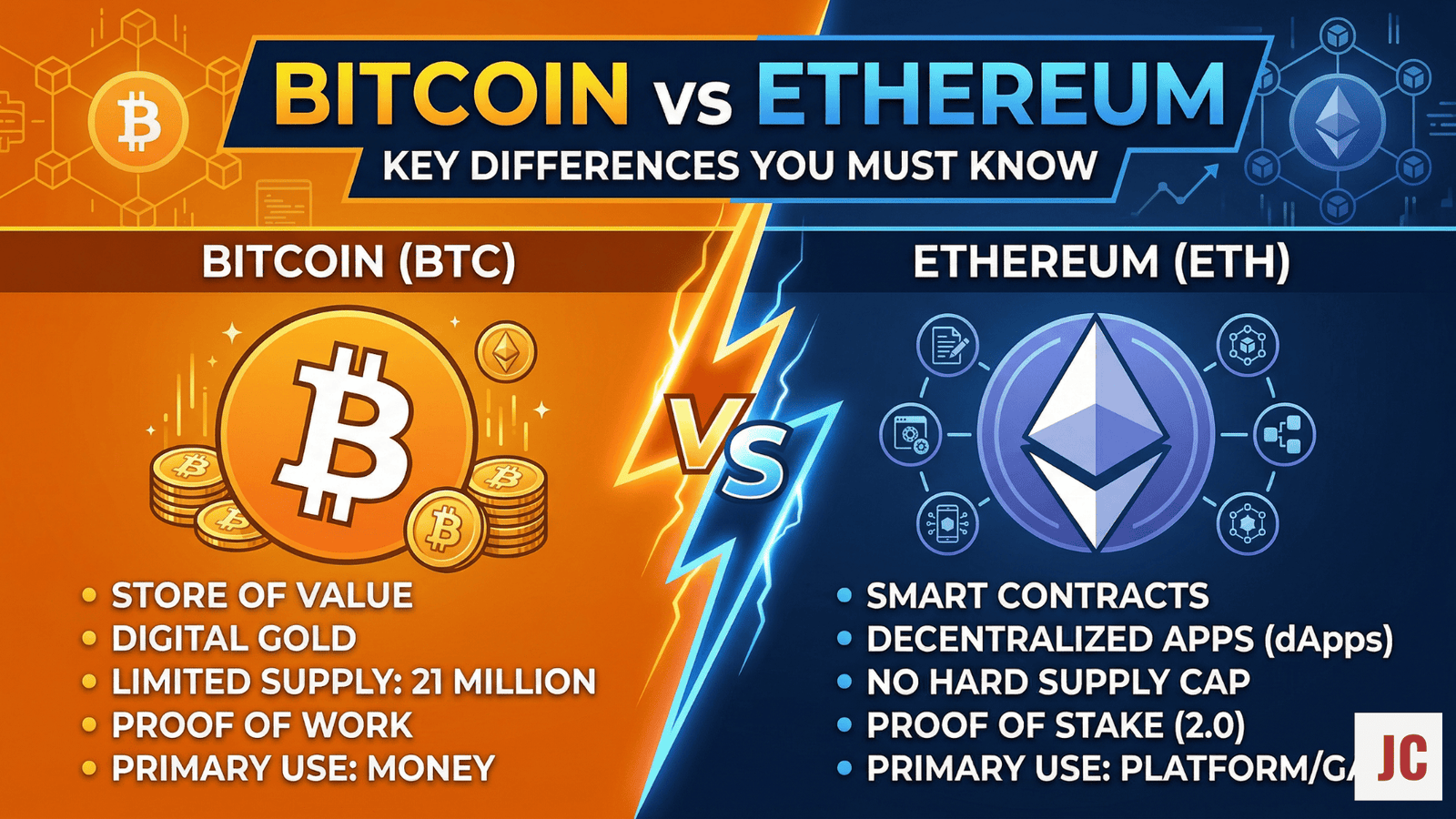
There will only ever be 21 million BTC. Because of this, Bitcoin is often compared to gold and is widely known as digital gold.
Key idea
👉 Bitcoin is digital money — often called “digital gold”
What makes Bitcoin special:
- Limited supply only 21 million coins
- Decentralized (no government controls it)
- Strong security via blockchain
- Store of value (like gold)
Best use case
✔ Long-term investment
✔ Hedge against inflation
✔ Value storage
What Is Ethereum?

Ethereum (ETH) was launched in 2015 by Vitalik Buterin.
Since then, it has grown into one of the most important blockchain platforms in the world.
Unlike Bitcoin, Ethereum is not just money — it’s a platform.
In other words, it allows developers to build applications directly on the blockchain.
One of the key features of Ethereum is smart contracts.
These are self-executing programs that run automatically when certain conditions are met. As a result, Ethereum can be used for much more than simple transactions.
What makes Ethereum unique
- Supports smart contracts
- Runs decentralized applications (dApps)
- Powers DeFi, NFTs, Web3
- Programmable blockchain
Best use case
✔ Building apps
✔ DeFi & NFT ecosystem
✔ Innovation & tech growth
Bitcoin vs Ethereum (Key Differences)
| Feature | Bitcoin (BTC) | Ethereum (ETH) |
|---|---|---|
| Purpose | Digital money | Smart contract platform |
| Supply | Fixed (21M) | No strict limit |
| Speed | Slower | Faster |
| Use case | Store of value | Apps & DeFi |
| Founder | Satoshi Nakamoto | Vitalik Buterin |
Which Is Better for You?
🟡 Choose Bitcoin if
- You want safe, long-term holding
- You believe in digital gold
- You prefer simplicity & stability
🔵 Choose Ethereum if
- You want growth & innovation
- You’re interested in DeFi / NFTs / Web3
- You accept higher risk for higher potential
Final Thoughts
There is no absolute winner between Bitcoin and Ethereum.
In fact, both cryptocurrencies serve different purposes and solve different problems in the digital world.
Bitcoin represents value. It was designed to be a secure, decentralized form of money—often referred to as digital gold. Because of its limited supply, many investors see Bitcoin as a long-term store of value and a hedge against inflation.
On the other hand, Ethereum represents innovation. It goes beyond just being a currency. Instead, it provides a powerful platform for building decentralized applications, smart contracts, and the future of Web3 technology.
If you think long-term
- Bitcoin is like gold stable, trusted, and focused on preserving value
- Ethereum is like the internet dynamic, evolving, and full of possibilities
Therefore, the real question isn’t which one is better—but which one fits your goals.
For long-term investors, Bitcoin may offer stability and security.
Meanwhile, Ethereum may provide higher growth potential through innovation and technology.
Ultimately, both can coexist and most likely will.
That’s why many experienced investors choose to hold both, creating a balanced portfolio that combines strength and growth.
About The Author